
Beneficial Ownership Verification: What a Defensible Process Looks Like in 2026
The CTA registry now covers almost no U.S. entities. Your own verification obligation is untouched, and there is no longer a database to lean on.
Rodolfo Santos
Real Estate Compliance Attorney & Co-Founder, VeriKYC
Why Beneficial Ownership Is Still Your Problem
The Corporate Transparency Act changed how U.S. businesses talk about beneficial ownership. It changed far less about what regulated firms actually have to do.
If you run a fund, manage a real estate entity, or advise clients through a law firm or lending operation, you have two distinct obligations that are easy to confuse. The first is your own company's reporting obligation to FinCEN. The second is your obligation to identify and verify the beneficial owners of the clients and counterparties you onboard. The CTA rollback narrowed the first almost to nothing. It did not touch the second.
That distinction is the whole article. What follows covers where CTA reporting actually stands, who counts as a beneficial owner, and what a defensible verification process looks like when there is no registry to lean on.
Where CTA Reporting Actually Stands in 2026
Enacted as part of the Anti-Money Laundering Act of 2020, the CTA was designed to make it harder to hide illicit money behind anonymous shell companies by requiring most U.S. companies to report their beneficial owners to FinCEN.
That is not the rule in force today.
In March 2025, FinCEN issued an interim final rule redefining "reporting company" to cover only entities formed under the law of a foreign country and registered to do business in a U.S. state or tribal jurisdiction. Entities created in the United States, meaning every Delaware LLC, every Wyoming corporation, every Nevada holding company, were exempted entirely, along with their beneficial owners. They are not required to file, not required to update previously filed reports, and not required to correct them.
The practical effect removed more than 99 percent of the entities originally within scope. A May 2026 Government Accountability Office report examining the resulting gaps noted that U.S.-formed shell companies continue to present significant illicit finance risk, and that the exemption leaves that risk substantially unaddressed.
What remains in force:
- Foreign entities registered to do business in the U.S. are still reporting companies and must file beneficial ownership information, with the significant carve-out that they are not required to report beneficial owners who are U.S. persons.
- Updates within 30 days of a change to previously reported information still apply to those foreign reporting companies.
- Civil penalties for wilful non-compliance, currently up to $591 per day plus potential criminal liability, still apply to entities that remain in scope.
- The Beneficial Ownership Secure System still exists, but it is now populated with a narrow and unrepresentative slice of entities, which makes it close to useless as a corroboration source for domestic customer due diligence.
For the full picture of what the rollback changed and what it did not, The Corporate Transparency Act After the Rollback covers the reporting side in depth. This article focuses on the diligence side.
Who Counts as a Beneficial Owner
The CTA's definition remains the reference point most compliance programs use, and it maps closely to the Customer Due Diligence Rule that governs your own verification work. A beneficial owner is any individual who, directly or indirectly, either:
- Exercises substantial control over the entity, or
- Owns or controls at least 25 percent of the ownership interests of the entity
"Substantial control" is intentionally broad. It captures senior officers, individuals with authority over major decisions, and anyone with significant influence over the company's finances or structure, even without formal equity ownership. A managing partner at a fund or a general counsel at a real estate holding company may qualify regardless of their ownership stake.
The 25 percent threshold applies to both direct and indirect ownership. Ownership through trusts, holding companies, or other intermediary structures counts. If a trust owns 30 percent of an LLC and you are the trustee with discretion over distributions, you likely meet the definition.
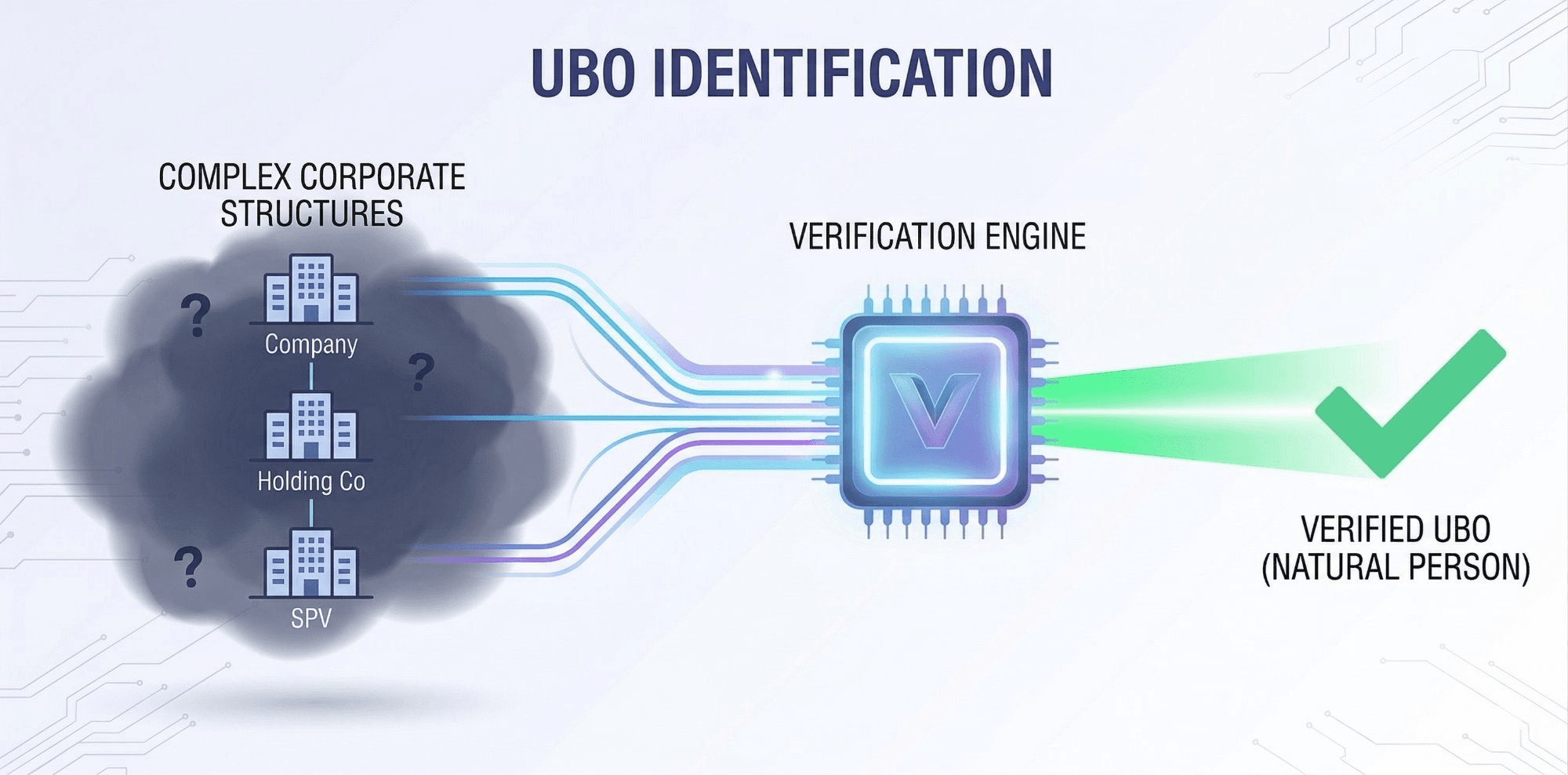
Identifying every beneficial owner in a multi-layered entity structure is not a trivial exercise. It requires mapping ownership chains, reviewing operating agreements, and making judgment calls on what substantial control actually means in practice. Ultimate Beneficial Ownership works through the mechanics of untangling those chains.
Verification Is a Separate Obligation From Reporting
Reporting to FinCEN is one thing. Verifying the beneficial ownership of your own clients and counterparties is a separate, parallel obligation under anti-money laundering rules, and it is the one that survived intact.
Financial institutions, investment advisers, real estate professionals, and lenders are required under the Customer Due Diligence Rule to identify and verify the beneficial owners of legal entity customers: each individual owning 25 percent or more, plus one individual with significant managerial control. That rule predates the CTA entirely and was untouched by the rollback.
If anything, the rollback made the job harder. The registry that was supposed to corroborate customer-provided information does not exist for the entities that matter most. You cannot look up a Delaware LLC's beneficial owners in a federal database, because that database has nothing in it for domestic entities. Whatever your client tells you about their ownership structure, you are the one who has to verify it.
Several other frameworks reinforce the same requirement from different directions:
- FinCEN's Residential Real Estate Rule, effective 1 March 2026, requires reporting of beneficial owners of transferee entities and trusts in non-financed residential purchases, with no exemption for domestic entities.
- OFAC's 50 percent rule requires U.S. persons to determine whether an entity is owned, directly or indirectly, 50 percent or more in aggregate by blocked persons. Making that determination requires knowing the ownership chain.
- The SEC Investment Adviser AML rule, effective 1 January 2028, will require registered advisers to implement full AML programs including beneficial ownership verification procedures.
If you are managing a fund or a VC portfolio and your current process is a spreadsheet and an email chain, that last deadline gives you a defined window to fix it.
The Practical Compliance Gap Most Firms Face
Knowing the rules and executing them consistently are two different things. The firms that struggle most with beneficial ownership verification tend to share a few characteristics:
- Onboarding runs through ad hoc email requests, which creates inconsistent document collection and gaps in the audit trail
- AML screening against a recognised risk database either does not exist or is done manually and infrequently
- Compliance files are scattered across email threads, shared drives, and individual inboxes
- When an LP, regulator, or auditor asks for documentation, pulling a complete file takes days
VeriKYC is built for this gap. The platform covers document collection through smart intake forms, AI-powered identity and document verification, and AML screening via LSEG World-Check, the risk intelligence database used by more than 300 global financial institutions. The output is a complete, audit-ready KYC file generated in under 60 seconds rather than a dashboard entry. For firms onboarding 20 to 200 clients or LPs per year, that structured, documented process is what stands between you and a compliance gap when regulators come asking.
What a Defensible Verification Process Looks Like
Whether you build it in-house or use a purpose-built platform, a defensible process needs to cover several things consistently.
Consistent Document Collection
Every client or counterparty that is a legal entity should go through the same intake process. You need the entity's formation documents, a current ownership chart, and identity documents for each individual who meets the beneficial owner definition. Smart intake forms that prompt for exactly what is needed reduce back-and-forth and prevent gaps from forming in the first place.
Identity Verification Against the Documents Provided
Collecting a passport copy is not the same as verifying it. A proper verification step checks that the document is authentic, that the individual's identity matches the document, and that the document is current. This is where AI-powered verification adds real value over manual review.
AML Screening Against a Recognised Database
Each identified beneficial owner should be screened for sanctions, PEP status, and adverse media. The LSEG World-Check database is the recognised standard in this space. Screening should be documented with a timestamp and the specific database version used, so you can demonstrate what was checked and when.
A Packaged, Retrievable Compliance File
The output of your verification process needs to be retrievable on demand. A compliance file containing the collected documents, verification results, AML screening outputs, and a timestamped audit trail is what satisfies LP due diligence requests, regulatory examinations, and internal audits. Scattered email threads do not.
Ongoing Monitoring and Refresh
Beneficial ownership changes. People are added to sanctions lists. PEP status shifts. Your process should include a trigger for re-screening when ownership structures change, and a schedule for periodic refresh, typically annually for lower-risk clients and more frequently for higher-risk ones.
For a broader look at how to structure this end to end, the automated KYC/AML guide covers the full workflow in practical terms.
The Broader Regulatory Convergence
Beneficial ownership does not sit in isolation. It runs through AMLA 2026, the FinCEN residential real estate rule, OFAC's 50 percent rule, and the forthcoming SEC Investment Adviser AML requirements. Each of these touches ownership transparency in some form.
The pattern across all of them is consistent: regulators want to know who ultimately owns and controls the entities moving money through the financial system. The federal government stepped back from collecting that data centrally for domestic entities. It did not stop requiring private institutions to obtain it.
These obligations reinforce each other. A firm with a strong beneficial ownership verification process for its KYC program will find every one of these frameworks easier to satisfy, because the underlying information is already being collected and documented systematically.
Frequently Asked Questions
What is the difference between CTA beneficial ownership reporting and KYC beneficial ownership verification?
CTA reporting is a company's obligation to report its own beneficial owners to FinCEN. KYC beneficial ownership verification is your obligation to identify and verify the beneficial owners of your clients and counterparties as part of your AML compliance program. These are separate requirements, and the March 2025 interim final rule narrowed the first without affecting the second.
Do U.S.-formed companies still have to file beneficial ownership reports with FinCEN?
No. Under the interim final rule FinCEN issued in March 2025, "reporting company" covers only entities formed under foreign law and registered to do business in a U.S. state or tribal jurisdiction. Domestic entities are exempt from filing, from updating previously filed reports, and from correcting them.
Can I rely on FinCEN's beneficial ownership database for customer due diligence?
Not for domestic entities. The database now contains only foreign reporting companies, and those are not required to report beneficial owners who are U.S. persons. For the vast majority of legal entity customers, there is nothing in the registry to query, so your own verification remains the only source.
Does the CTA apply to investment funds and VC firms?
Most domestic funds and the entities they manage now fall outside CTA reporting entirely following the 2025 rollback. Separately, the SEC Investment Adviser AML rule effective 1 January 2028 will impose beneficial ownership verification obligations on registered advisers regardless of CTA status.
How do I handle beneficial ownership verification for entities with complex ownership structures?
Trace ownership chains through each intermediary layer until you identify every individual who directly or indirectly owns 25 percent or more, or exercises substantial control. This typically requires reviewing operating agreements, trust documents, and shareholder registries. Documenting that analysis in your compliance file is as important as the conclusion you reach.
What documents should I collect for beneficial ownership verification?
At minimum: a government-issued photo ID for each beneficial owner, proof of address, and documentation of the ownership structure such as an operating agreement, cap table, or equivalent. For higher-risk clients, enhanced due diligence may require additional documentation including source of funds or source of wealth evidence.
How often should beneficial ownership information be re-verified?
Most compliance frameworks recommend annual re-verification for standard-risk clients and more frequent review for higher-risk relationships, or whenever a material change occurs such as a shift in ownership structure, a new regulatory designation, or a sanctions event. Your written AML policy should define the specific refresh schedule for each risk tier.
Rodolfo Santos
Rodolfo Santos is a real estate compliance attorney with 10+ years of experience in cross-border transactions and the co-founder of VeriKYC, an AI-powered compliance platform for real estate professionals. He has closed over 150 property transactions worth more than €50 million.